
This video is pretty much the same exact thing as the article below. Enjoy however you please.
In previous articles about our stats, I’ve talked more in depth about the philosophy behind it. If you want to see more of that, check it out here. But the gist is that we think the ‘big arb’ way of doing this is big BS. We don’t think we need big equipment and big overhead to do good work. And we don’t think you do either. We don’t prioritize maximizing our revenue, we prioritize doing good things to trees. Leading people to make good decisions. That means talking people out of doing silly things sometimes too.
We equip for the work we want to do. This means we’ve only equipped ourselves to take care of trees. In our area, most tree companies want to kill trees. So we’re here to fulfill a different market demand. This means we don’t need gigantic chippers or cranes at all.
So we track these kinds of things to prove that you can have a successful business without needing to prioritize tree killin’. For context, we’re a two-man operation that has some part time arborist help from time to time. This year we only rented an aerial lift once; everything else was climbed.
SO here we go.
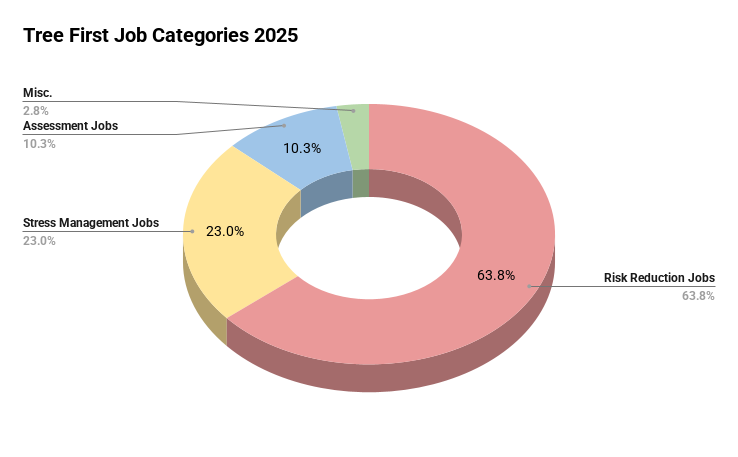
Each of the previous articles we’ve written about our annual stuff includes a categories breakdown. Categorically, what kinds of jobs do we take on?
This pie-chart accounts for a total of 427 jobs this year. All of these charts and tables are percentages relating to the number of jobs, not the percentage of our revenue.
If we were paid, it counts into this chart. The risk reduction stuff is pretty much all pruning. Even though a little bit of clearance doesn’t really reduce any risk to a meaningful degree, it is counted in that domain. Plenty of jobs have multiple different things we do on them. Sometimes we do a soil treatment at the same time we do a pruning. Whichever domain was the primary goal of the job, where the most time or effort was spent, that’s what domain the job qualifies for. Too much to fuss about with to try to account for multiple domains at once.
Stress Management jobs are like treatments and soil work. Assessments are what you think, like analyses and consultations. And then we’ve got miscellaneous stuff which is like the occasional stump grinding, veteranization, planting, stuff that doesn’t neatly fit elsewhere or represent a big percentage of what we do.
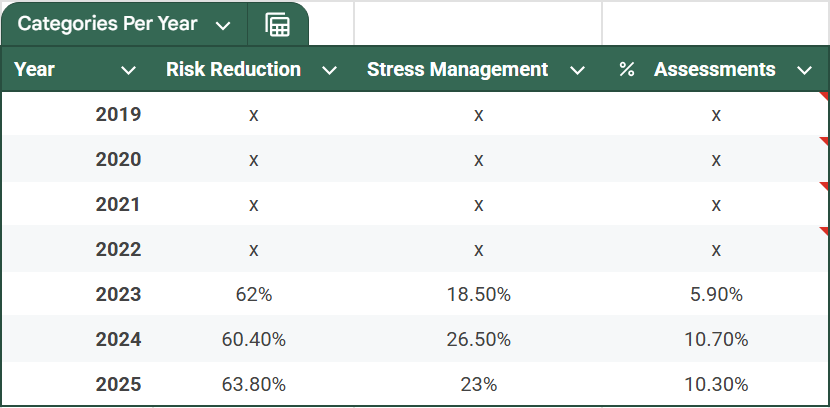
Looking back at 2023 and 2024, these percentages are pretty consistent even as we take on more jobs each year. While our practice began in 2019, we didn’t consider recording stats like these. In theory, it might be possible to walk-through every old work order to classify them. But honestly that sounds like quite the headache lol. It is much easier to track as the year progresses.
Next, and pretty importantly, we look at the percentage of time we haul debris off site. Many of you know we roll around in pretty much just a big van. If you want to see that, we’ve got a video showing that.
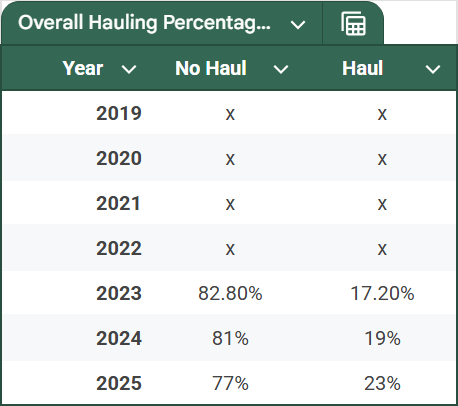
In just a big van, where do we put wood chips? Most of the time we leave ‘em. If you want to see the previous years’ exact percentages, you can see those. I’ll put on screen previous years, but I know they’re all within single-digit percentages, so again, pretty consistent across the years we’ve been recording this data.
So in 2025, across all of our jobs, we hauled nothing off of a job 77% of the time. Which is pretty consistent with the previous years we’ve recorded this data.
For the risk-reduction jobs, this includes all pruning, storm damage, the like 10 removals we did this year, 70% of that time material stayed on site. The other 30 percent of the time we had to either bring Jack’s truck or rent a trailer to remove the material.

For stress management stuff, 82% of the time we hauled nothing off site. This is sort of intuitive, most treatments don’t create anything that could be hauled off anyways. But when we do root crown excavations or big soil improvement jobs, sometimes there’s a lot of sod removed that does get hauled off.
Obviously the assessment stuff and miscellaneous jobs don’t require any hauling whatsoever.
The not-hauling material off site is part of this whole ‘stewardship’ mindset. Taking care of the environment you live in. The wood chips aren’t waste; they can be used for something. Our clients receive estimates with the chipping and hauling as separate items. This means they’ll also see that they can save money when they keep their material on site. It’s a win-win.
Because we’re good at pruning, this also works for us because we’re not generally producing mountains of wood chips. By doing end-weight reductions instead of over-pruning, most of the time the piles of wood chips we leave behind are easily manageable.
The assessments and stuff are kind of a loss leader. We can sometimes get pretty into the weeds with some complex assessments, and generally we do so at a loss. Not only is it fun for me, it’s also gaining clientele pretty much every time. Hiring a professional to actually think hard about their trees can be pretty cost prohibitive for homeowners. If I charged someone the hours it takes to collect the data, synthesize it, think about it, I wouldn’t be able to actually do any of it. I think here we don’t really have a strict financial return-on-investment mindset. The ROI is more in doing cool and interesting things that helps people help trees and the environment.
ANYWAY, the next stuff is all new data we collected this year.
Firstly, we collected all of the individual species we touched this year. This doesn’t include consultations. But if we pruned, assessed, treated, anything, we recorded it. But we recorded a total of 90 different species, which is pretty cool. But it makes for a seriously complex pie-chart. So instead I converted that data into a chart that contained only the genera of trees we worked on. Still a lot, at 46 different genera. Of 674 individual trees. I know this pie-chart is horrifying lol.
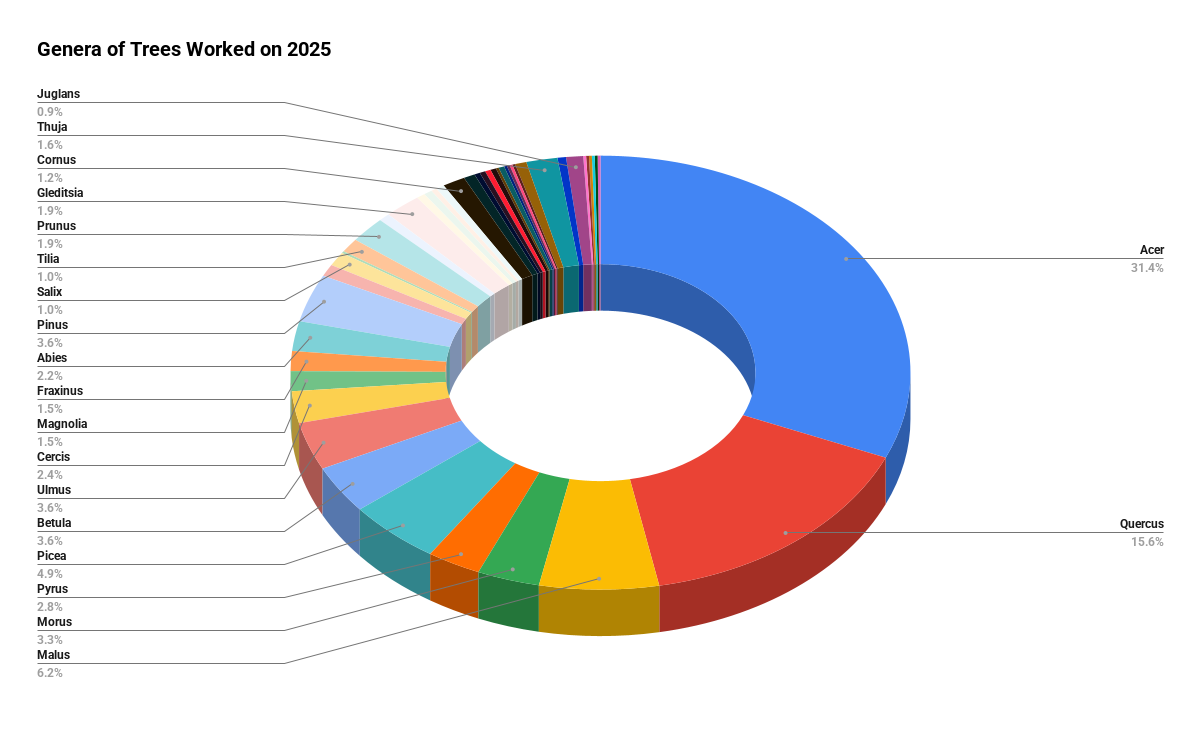
I found these percentages to be amusing. Especially that humongous 31.4% were some flavor of maple. Followed by a ton of oaks, and then lastly a lot of crabapples and apples lol. Making maples, oaks, and crabapples, that is 53.2% of the trees we touch. I don’t really know what practical things we can do with this data but it is cool to see.
The other new piece of data we tracked has a bit more we could do with and extrapolate from. This is sort of an extension of the job categories data. This is more specific than that. I might need some help with making my data look prettier. Maybe pie-charts just aren’t the way lol.

Red-slices are risk-reductive things. So 23.1% of the time we’re working on trees, we are reducing certain areas of the crown. End-weight reduction. I know I said clearance isn’t really reducing risk of breakages per se, but it goes into this category. 12.9% of the time we’re getting trees away from stuff. 10.7% of the time the main objective is getting large dead stuff out of trees.
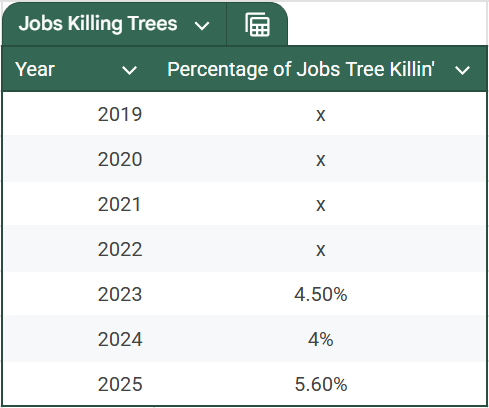
Only 5.6% of the time are we killing stuff. Which is also consistent with previous years work. Look, I know we really emphasize keeping trees around, but we’re also not zealous about that. Sometimes trees do have to be removed, we just argue that it is too often when alternatives exist. Sometimes you don’t want a mulberry growing out of the foundation of the house, right? But most of the time, we do not take removal jobs. We aren’t equipped for them, purposely.
Back to the Touched Trees pie chart, 2.4% of the time we’re doing storm-damage stuff. With our low-profile and lack of heavy equipment, storm damage clean-up is pretty challenging for us. Storm damage with 2 guys isn’t all that easy. We only take on storm damage for existing clients, we don’t take new clients for clean-ups. We usually handle the after-care, we tell our clients not to let any of the clean-up crews touch the trees themselves.
Sure, plenty of money to be made for doing big clean-ups. We aren’t equipped for it and it isn’t work we necessarily want to do. We don’t think we have to supply every single tree-related need. But because we do mostly reduction work, most of our trees don’t break to be honest lol.
Again, back to the Touched trees pie chart; into the yellow colors, 16.5% of the time we’re touching a tree we’re treating it for something. We do have a lot of ash trees around us. This is pretty much the only insecticide we use in our practice. We aren’t doing “routine” sprays of insecticides. I like seeing herbivory on our trees. Shows our trees contribute to the food-web here.
Like you saw earlier, we work with a lot of apples and crabapples. So this is fungicides and bactericides. Apple scab, rusts, fireblight, that stuff. Boring if I’m being honest.
Got root crown excavations and soil improvement zones at 3.6% and at 1.9%. Pretty much all soil improvement zones also include an RCX. This number is actually lower than previous years, but the ones we did this year were all BIG.
I think there is some interesting stuff we can do with this bit of new data.
OK moving onwards to wrap it up. At the end of the 2024 article we talked about a question we get. How does this business model grow? A good question. Kev told us a long time ago that we need to be very mindful and deliberate with how we grow because it is easy to get stuck doing things you don’t want to do. And again, we don’t have the express goal to become a humongous company. We just want to work for the trees in our community.
For us, instead of growing with more ground guys, bigger chippers, bigger whatever, we’re adding an existing practitioner with their own clients and equipment into our business. To grow in depth, not in width. Adding a third full time arborist who already has his own clientele and equipment.
Tree First began as a proof-of-concept project to see if it was possible to run a tree care company without the BS of the common production-model. And it has evolved and grown into our livelihoods. Fulfilling not only our salaries but also our curiosities and skills too.
It is fun. Seriously, if you’re considering going off on your own, we hope you can see this as an avenue to consider. You don’t have to be huge. You can be deliberate, small, make money, and actually improve the community you live in.
Good arborists influence their communities. You can be a force in your community for preserving trees if your community trusts you. And you don’t really get that by killin’ all the trees. The way you do business has an affect on the places you live. The small-arb model, without the deliberate intent to expand expand expand, can be used as a means for good arborists to take part in the mission.